Yayınlandı: 9 Mart 2011
Kategori: Kataloglar
Alışveriş Sepeti

PowerQuality
Power Quality
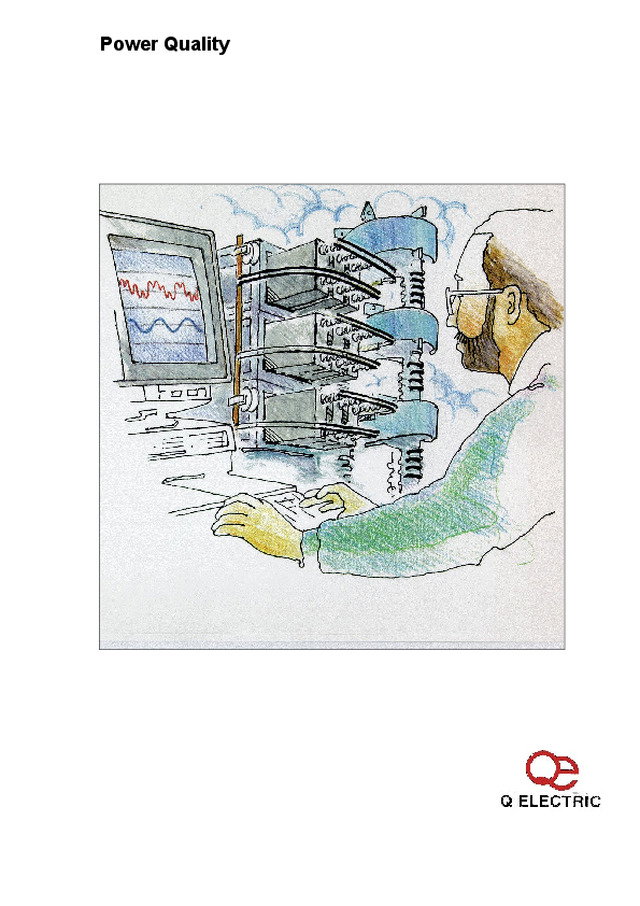
What is Power Quality?Electric energy is one of the most important production factors in modern manufacturing industry. It is also an important commodity for the power utility industry. For both par- ties, the quality of electric power is becoming increasingly important. But what is Power Quality?High Power Quality means a high rate of efficiency in the networks with a low level of electrical disturbances. Electrical disturban- ces can be categorized in voltage variations, harmonics, interruptions and unbalance. Here certain phenomena can be defined, i.e. dips, transients, flicker etc., but also reactive power balance, power factor and network losses.Power Factor ImprovementA high power factor in the network means low losses, high voltage stability and good power flow control. It is achieved by balan- cing the reactive power consumption in the network by switching capacitors or reactors. Cover: Q ELECTRIC specializes in power quality measure-ments, evaluation and analysis. Time Dn Frequency Diagram 1. Power measurement gives the input needed for calculating and designing power factor compensation. Diagram 2. Harmonic measurements are used to define the harmonic distortion in the network and give the input for calculating harmonic filter details. The need for installation of capacitor banks and switching sequences is calculated from network models and power flow measure- ments in the network, see diagram 1.Harmonic FilteringThe fastest growing power quality phenome- non is harmonics, much due to the increasing use of electronic appliances in households and industrial networks. Harmonics, i.e. vol- tage and current with higher frequency than the network fundamental frequency, are gene- rated by non-linear loads, such as frequency converters, rectifiers and power electronics. Harmonic distortion in a network also causes amplification and resonance problems when capacitor banks are installed, increasing net- work losses and production disturbances in industrial machinery.Harmonic measurement, evaluation and cal- culation based on mathematical models help solving these problems. Installations of pas- sive or active filters or redesigning existing capacitor banks into filters are well proven methods, see diagrams 2 and 3. Power 2
Frequency Diagram 3.The network impedance at different frequencies defines the parallel resonance frequency. Diagram 4. Measuring transients could be time consuming and difficult, but is usually the only way to solve problems with erratic disturbances. Transient EliminationSwitching capacitor banks generate transients that can cause disturbances and equipment failures in production facilities as well as in home electronic appliances. Transients are also generated by atmospheric phenomenon like lightning and network switching. Tran- sients can be a nuisance due to their irregu- larity and non-foreseeable nature and the solution to solve the problem is found only after an extensive analysis, see diagram 4.Q-ELECTRIC Provides Complete ServiceQ-ELECTRIC specializes in providing com- plete Power Quality services for industrial as well as utility networks. Among these servi- ces are measurements of:- active and reactive power- power factor- current and voltage variations- harmonics- transients- etc.. The measurements are performed according to applicable standards and the results are analysed and evaluated with theoretical mo- dels and presented in a detailed report. The results from the measurements are then used as input for solving Power Quality problems or increasing the network efficiency. These solutions include for instance:- analysing the best location for reactive power compensation in the network- calculating switching cycles for opti- mum power flow control in the network- sizing capacitor banks for shunt- or series compensation- calculating and designing harmonic filters for suppression of harmonic distortion- sizing surge arresters for transient over-voltage protection.For further details on Q-ELECTRIC servi- ces, references or other information, please do not hesitate to call or e-mail. Impedance Voltage Time 3
Q ELECTRIC Nätkvalitet AB Lovisagatan 4 SE-115 23 STOCKHOLM, Sweden E-mail [email protected] Phone +46 8 663 18 69 Fax +46 8 662 90 92 SECAP A04QE Edition 2, 2000-06 Produced in cooperation with ABB Capacitors AB. Printed with an INDIGO digital printing press at Elanders Novum, Västerås, 0203