











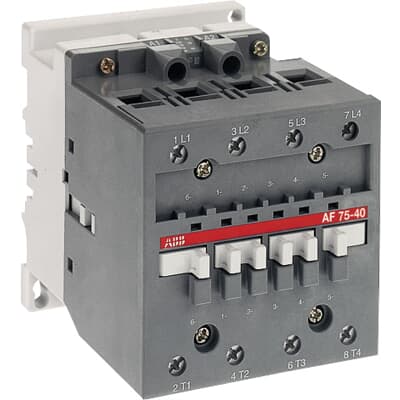
AF75-40-00 20-60V DC Contactor

AF75-40-00 20-60V DC Contactor
AF75 4-pole contactors are mainly used for controlling non-inductive or slightly inductive loads (i.e. resistance furnaces...) and generally for controlling power circuits up to 690 V AC and 440 V DC. The contactors can also be used for many other applications such lighting... The AF... contactors are fitted with an electronic coil interface which accepts a wide control voltage range, on AC 50/60 Hz or DC supplies. The same contactor can accept various supply voltages according to the different countries where the electrical equipment will be installed, or some fluctuation in the control voltage due to the local supply or network. The AF... contactors are also fully suitable for operation in AC or DC control circuit liable to voltage interruptions or voltage dip risks. Advantages: - Wide voltage range, e.g. 100 ... 250 V AC and DC - Can manage large voltage variations - Reduced power consumption - Very distinct closing and opening - Noise free - Can withstand voltage interruptions or voltage dips in the control supply (≤ 20 ms). The AF... series 4-pole contactors are of the block type design. - Main poles and auxiliary contact blocks: 4 N.O. main poles, front and side-mounted add-on auxiliary contact blocks - Control circuit: AC or DC operated - Accessories: a wide range of accessories is available.
Ürün kimlikleri
SKU: 1SBL417201R7200
EAN: 3471522115324
GTIN: 3471522115324
MPN: AF75-40-00 20-60V DC
Teknik özellikler
| EFI00008 | - |
| EFI00040 | - |
| EFI00049 | - |
| Modular version | - |
| Rated operation power NEMA | - |
| Voltage type for actuating | - |
| Rated control supply voltage DC | |
| Rated operation power at AC-3, 400 V | - |